Finapres Medical Systems offers equipment with proven and advanced patented technology. Finapres systems are built on combinations of four technologies:
The volume clamp with physiocal technology is the core technology providing accurate finger pressure measurements.
2. Brachial arterial reconstruction technology
The patented brachial arterial reconstruction technology translates the finger pressure into the commonly used brachial arterial blood pressure.
3. Return to flow technology
The patented return to flow technology is a calibration technique to calibrate the relationship between finger pressure and brachial pressure.
4. Modelflow® technology
The Modelflow® technology is also patented and used to derive hemodynamic parameters from pressure information, waveforms and patient information (gender, age, height, weight).
The absolute accuracy with respect to blood pressure measurements has been found in comparative studies with intra-arterial blood pressure as the reference*. Recently the Finometer® passed the AAMI/SP10 and BHS standards**. The AAMI/SP10, for example, demands that findings between stethoscope measurements and the automated device are less than 5± 8 mmHg (average ± standard deviation). The BHS demands, for example, that at least 50% of the measurements between stethoscope and device are less than 5 mmHg and that the difference is less than 15 mmHg in 90% of the measurements.
* Blood Pressure Monitoring (2003) 8,1, 27-30. Please click here to access the article
* Clinical Autonimic Research (1991) 1,1, 43–53. Please click here to access the article
**Journal of Human Hypertension (2004) 18, 79–84. Please click here to access the article
The volume-clamp method was first introduced by Czech physiologist Prof. J Peñáz in 1967. With this method, finger arterial pressure is measured using a finger cuff and an inflatable bladder in combination with an infrared plethysmograph, which consists of an infrared light source and detector.The infrared light is absorbed by the blood, and the pulsation of arterial diameter during a heart beat causes a pulsation in the light detector signal.
A servo-controller system usually defines a target value or setpoint and a measured value that is compared with this setpoint. In the servo-controller the setpoint is the signal of the plethysmograph (unloaded diameter of the arteries) that must be clamped. The measured value comes from the light detector. The amplified difference between the setpoint and measured value, "the error signal," is used to control a fast pneumatic proportional valve in the frontend unit. This proportional valve modulates the air pressure generated by the air compressor, thus causing changes in the finger cuff pressure in parallel with intra-arterial pressure in the finger so as to dynamically unload the arterial walls in the finger. The cuff pressure thus provides an indirect measure of intra-arterial pressure.
Defining the correct unloaded diameter of a finger artery is crucial for the accuracy of the measurement. Changes in hematocrit, stress and the tone of smooth muscle in the arterial wall will affect the unloaded diameter. Therefore, the unloaded diameter is usually not constant during a measurement and must be verified at intervals. Periods of constant cuff pressure are used to adjust the correct unloaded diameter of the finger artery based on the signal from the plethysmograph in the finger cuff.
The Physiocal (abbreviation for Physiologic Calibration) algorithm in Portapres® and Finometer®, not only uses the amplitude, but also interprets the shape of the plethysmograph signal during periods of constant cuff pressure. By analyzing the plethysmograph signal at two or more pressure levels, the Physiocal algorithm, explores part of the pressure-diameter relation and is able to track the unloaded diameter of a finger artery, even if smooth muscle tone changes. The periodic interruption of a finger blood pressure measurement, with constant cuff pressure levels, is further referred to as "Physiocal".
Physiocal is the automatic algorithm that calibrates the finger arterial size at which finger cuff air pressure equals finger arterial blood pressure. Physiocal is built into Portapres® and Finometer® and users can determine whether they wish to use the Physiocal algorithm or switch it off during tests in which uninterrupted data-collection is required.
There is a delay of several dozen milliseconds between finger blood pressure pulsations and intra-brachial pulsations since the former travel further. In addition, their levels are generally lower and the waveforms appear more distorted, mainly due to reflections and pressure gradients.
To correct the distortion in finger pressure relative to brachial artery pressure, a frequency dependent filter can be used to restore the waveform at the brachial level. This brachial artery pressure reconstruction technique allows clinicians and researchers to obtain the brachial arterial pressure if they wish to perform a more precise measurement at the heart level. Waveform filtering is done in real-time.
Return to flow calibration is an individual upper arm cuff systolic calibration which can provide much higher accuracy of a measurement.
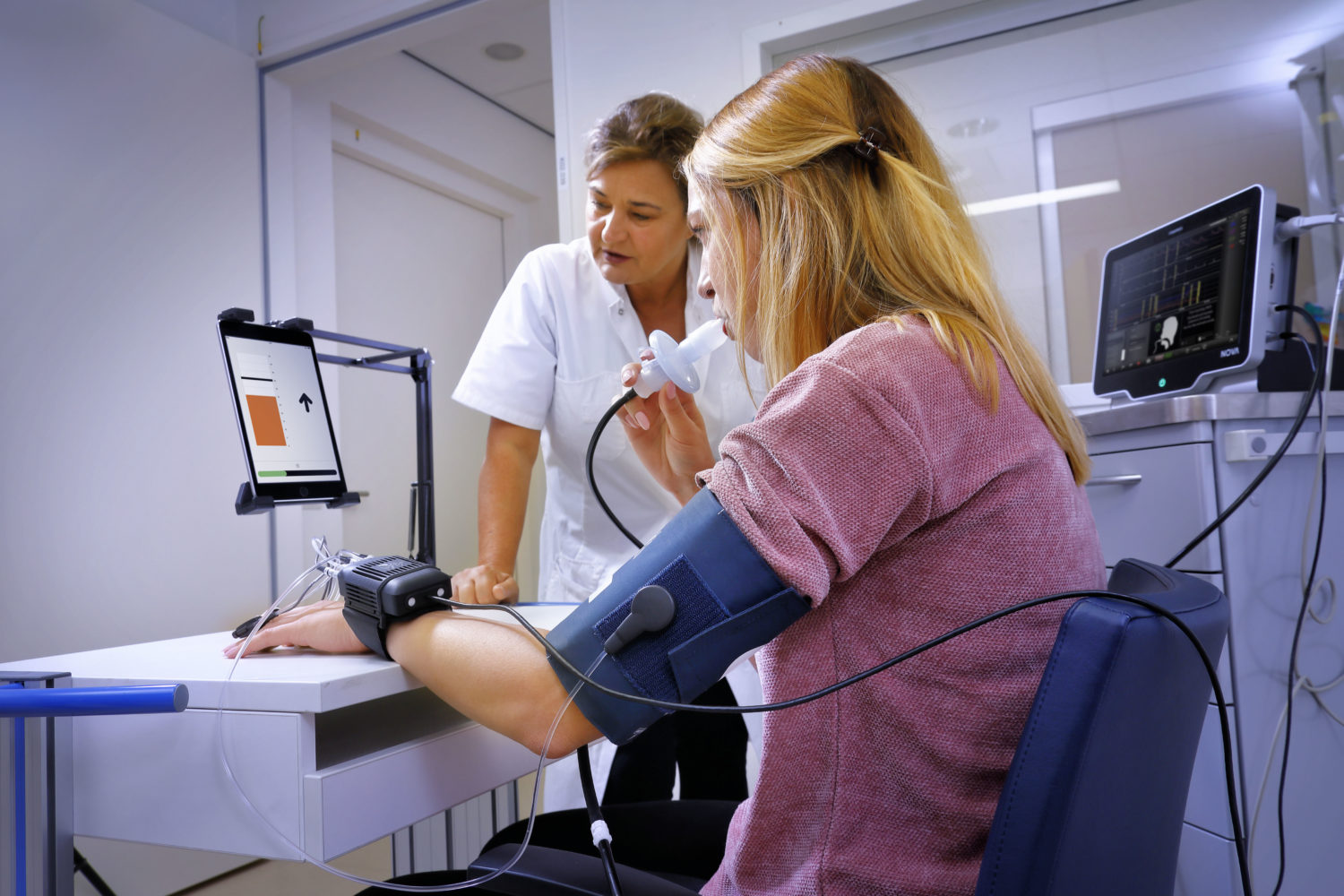
For this purpose, an arm cuff is wrapped around the same arm as the finger cuff and the operator can set the computer system to automatically inflate and deflate the arm cuff. When arm cuff pressure is supra-systolic, no pulsations can be sensed in the finger.
Modelflow® is a model-based method and algorithm used to compute the aortic flow waveform from an arterial blood pressure pulsation by simulating a nonlinear, self-adaptive (three-element Windkessel) model of the aortic input impedance .
Diagram of modelling flow from measurements of arterial pressure.
Left panel: non-invasive pressure as input to the model for one heartbeat.
Middle figure: three-element model of the aortic input impedance used to compute flow from pressure. Zo characteristic impedance of the proximal aorta; Cw 'Windkessel' compliance of the arterial system; Rp, total systemic peripheral resistance. The Zo and Cw elements have non-linear, pressure-dependent properties indicated by the stylized ∫ symbol. The peripheral resistance element, Rp, varies with time as symbolized by the arrow. P(t), arterial pressure waveform; Q(t) blood flow as a function of time; Pw(t) Windkessel pressure.
Right figure: the computed output of the model, i.e. aortic flow as a function of time.
The three-element model is well known in the field of physiology for its ability to compute stroke volume. Aortic characteristic impedance and Windkessel compliance depend nonlinearly on arterial pressure, and peripheral resistance adapts to changes in mean flow. The degree of nonlinearity depends strongly on the subject's gender, age, height and weight. Stroke volume is computed by taking the area under the flow pulse in systole. Cardiac output is the product of stroke volume and heart rate. Total systemic peripheral resistance equals the sum of the aortic characteristic impedance Zo and peripheral resistance Rp.
Modelflow® provides close tracking of changes in cardiac stroke volume and output and is integrated in our (embedded and PC) software. The combination of Modelflow® with advanced signal and pattern recognition techniques in BeatScope® software enables the computation of many cardiovascular parameters using an arterial pressure waveform as the sole input.